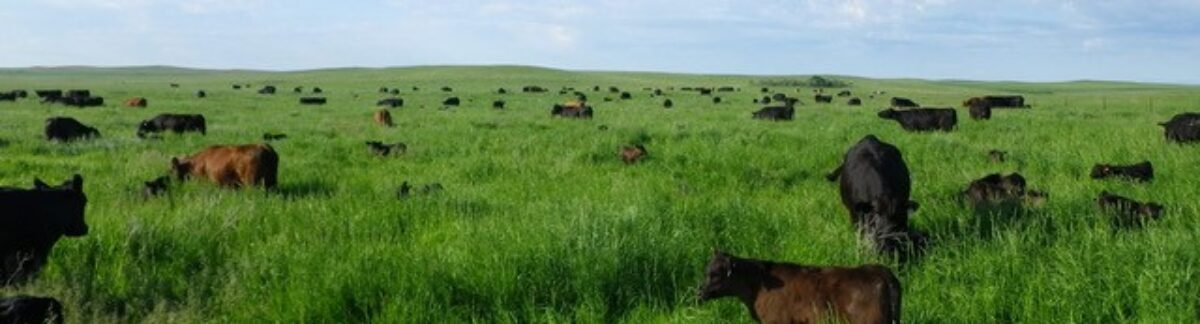
How well-managed grazing rebuilds soil, water, and wildlife habitat.
As pastures slow down for fall, it’s a good moment to look at what’s happening underground. On AGA farms and ranches, cattle, sheep, goats, and bison aren’t just raised on the land. They help build it.
When animals graze and then move on, they trim plants, press seed and manure into the soil, and leave the pasture to rest and regrow. Done well, that cycle feeds soil life, keeps living roots in the ground, and helps rain soak in instead of running off.
That’s the idea behind AGA’s Regenerative Land Health Standards. The goal is simple: improve the relationship between animals, soil, and ecosystems. Producers following the standards work from six principles:
• Understand the farm’s own context: soil, climate, and landscape
• Disturb the soil as little as possible
• Grow as many kinds of plants as possible
• Keep the ground covered
• Keep living roots in the soil year-round
• Bring livestock into the pasture’s nutrient cycle
Michigan State University C.S. Mott Professor of Sustainable Agriculture Jason Rowntree is examining the benefits and applicability of regenerative agriculture-based livestock systems.
Rowntree
Regenerative agriculture is a relatively new approach to livestock farming that emphasizes the reduction of farming inputs and restoring ecosystem services such as soil carbon sequestration and improved water cycling.
“These regenerative agriculture principles suggest that modern livestock systems can be redesigned to better capitalize on animals’ ecological niches as biological up-cyclers and may be necessary to fully regenerate some landscapes,” wrote Rowntree in a paper recently published in Frontiers in Sustainable Food Systems.
“Regenerative agriculture is a newer movement in agriculture with the overarching premise of trying to improve land while simultaneously growing food – meaning its aim is improving the land, improving the ecosystem, and improving productivity with certain ecological boundaries.”
Rowntree worked with Quantis and General Mills, as well as White Oak Pastures in Bluffton, Georgia, to conduct a whole-farm life cycle assessment from grazing land that was originally converted from degraded cropland. The team compared production outputs, greenhouse gas emissions, environmental footprints and soil health outcomes to a conventional, commodity production system of each respective species.
White Oaks Farms transitioned to regenerative agriculture practices in 1995. The 20-year study of the farm’s indicated considerably improvements in soil health and carbon sequestration in a transition from degraded cropland to perennial pasture.
The paper indicates benefits to a multi-species pasture rotation system that raises multiple types of livestock animals. Rowntree said in the context of this experiment, land use should also be considered.
“When comparing required land between the two systems for food production, (the regenerative techniques) required two-and-a-half times more land when compared to business as usual agriculture. Thus, while our model indicates that the farm studied can simultaneously produce protein while regenerating land, considerably greater land area is needed when compared to today’s agriculture,” he said.
Rowntree suggests these types of studies can add to the ongoing conversation around preserving farmland and protecting the environment, while producing food and remaining profitable.
“These complexities must be considered in the global debate of agricultural practice and land,” he said. “Do we throw this system out because it takes more land? No. Do we throw today’s agriculture out because it requires more energy? No. What we do is we try to blend the two and take some of these principles and put them into larger-scale agriculture to get better outcomes.”
~~read more at the link above.
Cookie Consent
We use cookies to improve your experience on our site. By using our site, you consent to cookies.
Cookie Preferences
Manage your cookie preferences below:
Essential cookies enable basic functions and are necessary for the proper function of the website.
Name
Description
Duration
Cookie Preferences
This cookie is used to store the user's cookie consent preferences.
30 days
These cookies are needed for adding comments on this website.
Name
Description
Duration
comment_author
Used to track the user across multiple sessions.
Session
comment_author_email
Used to track the user across multiple sessions.
Session
comment_author_url
Used to track the user across multiple sessions.
Session
WPForms is a user-friendly WordPress plugin for creating custom forms with drag-and-drop functionality.